
Our whole reality revolves around patterns.
Our brain learned which patterns are important and evolved according to them. Our program to seek patterns is essential for our physical survival and our social wellbeing.
Therefore we get rewarded with dopamine anytime we notice a new pattern. The ability to see connections is so important because it can literally change the way we perceive reality.
Here is an example. Before we understood and harnessed seasonal patterns our ancestors had to constantly move from one place to another. Only after we noticed the seasonal cycles things like agricultural life, domestication and farming arose. There is no need to explain how drastically this observation changed our lives.
The essence of human nature is all about solving problems and creating. That is what makes us humans in the first place. Therefore seeing and making connections is important not only for survival but for business, relationships, art, sports and pretty much any endeavor.
I’ve always admired the ability of some people to have an answer for everything in their pocket. The ones that can always make a reference, quote someone, tell a story related to the topic.
So how do you become better at recognizing patterns and making connections?
The bad news it this isn’t a straightforward skill. It’s rather a combination of many skills. Nobody can give you a step by step roadmap. The same way nobody can teach you how to become more creative. It’s a complex process but there are a few things you can consider doing.
One of those things is reading. Yes, I know it sounds like the generic advice that every guru seems to be giving out there but trust me. Reading creates small accumulations over time. These accumulations will make you better at noticing interconnections. You could see the common values between seemingly different domains. For example consuming psychology and marketing content will help you to see how others use persuasion techniques on you in everyday life.
Now, here’s where things get interesting. Most of us recognize patterns within specific domains – business , relationships, fitness and so on. But there are rare individuals who take pattern recognition to an entirely different level. They don’t just see patterns within fields; they see the patterns between patterns.
I’d like to introduce you to some of Ken Wilber’s work which I came across while reading Non-Fiction books. He is an American philosopher who has dedicated most of his life into creating a comprehensive frameworks. It’s about understanding human knowledge, consciousness, and development. He is what I would call a master synthesizers. The frameworks connect and insights from psychology, philosophy, science, spirituality, and mysticism.
Here are some of the main ideas from his work.
1) Holons and Holarchy
The Holon is something that is both a whole in itself and a part of a larger whole.
Here are some examples.
Atoms → molecules → cells → organs → organisms → ecosystems
Words → sentences → paragraphs → books
stars → star systems → galaxies → Universe
Each of these is a a structure within a structure.
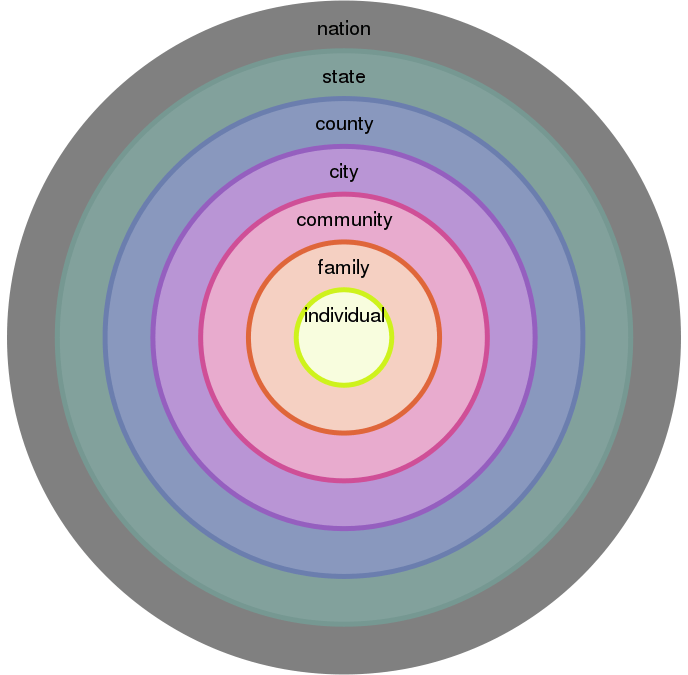
Everything is made of nested holons (he calls this a holarchy), and this pattern shows up universally. The important note is that every level should accept and transcend the lower levels and be accepted and transcended from the higher ones. There can’t be a successful business if its employes are not concerned about the brand’s goal. In the same way the business won’t work if the boss is concerend only about his personal material gain ( rejecting the lower levels).
2) The Four Quadrants
According to Wilber you can view anything through four fundamental perspectives.
Interior-Individual → subjective experience (thoughts, feelings, awareness).
Exterior-Individual → objective behavior and measurable phenomena (the brain, body).
Interior-Collective → cultural worldviews, shared meaning.
Exterior-Collective → systems, institutions, environments.
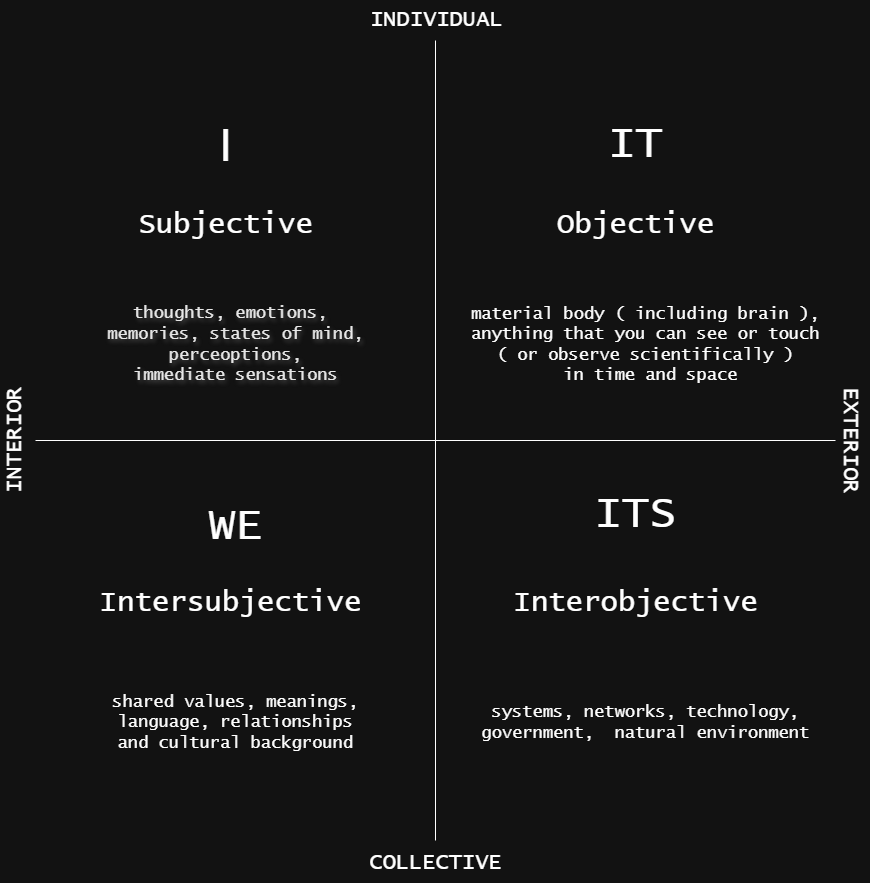
For me this framework is important because it helps you to understand how both internal and external factors form our perception and identity.
3) Developmental Levels (Stages of Growth)
This one is a huge topic. I recommend you to take a look at Dan Koe’s article about the developmental levels A Complete Knowledge Base Of HUMAN 3.0. There he goes in depth about this framework from his own perspective. I think it’s pretty good for people that are new to these frameworks.
Nevertheless here are some things to note.
Everything (individuals, societies, even cosmology) develops through stages of increasing complexity. These stages evolve in different domains: Cognitive , emotional, social and spiritual growth.
We can boil it down to three big stages of human growth that capture the essence:
Egocentric
Focus is on self and survival: my needs, my desires, my safety.
The world is seen mainly through my own perspective.
Morality is about avoiding punishment or getting rewards. Think: a child’s mindset, or adults who operate mainly from “what’s in it for me?”
The business example here would be a CEO operating from egocentric stage focuses on quarterly profits.
Ethnocentric / Conventional
Focus expands to my group, tribe, nation, religion.
Identity is defined by belonging and loyalty.
Morality is about following the rules, traditions, or authority of the group. Think: adolescence, or adults whose worldview is rooted in “my people vs. others.”
Here the CEO is interested mainly in the company’s culture and its development.
Worldcentric / Postconventional
Identity widens to include all human beings (and even all life).
Morality is about universal principles like justice, compassion, and care for all.
Perspective-taking expands—you can see through others’ eyes, not just your own group’s. Think: mature adulthood, global consciousness, and spiritual inclusiveness.
The CEO finally comes to the point where he combines his personal interest with the one of the company and his employees to make a positive environmental impact.
4) States of Consciousness
Humans have access to natural states: waking, dreaming, deep sleep. Spiritual traditions add meditative and mystical states (nondual awareness, formless awareness, etc.).
As opposed to the Developmental Levels the states of consciousness are more unstable and temporary. But they can be used to get a sense of a higher stage of development so you can eventually get there.
You’ve probably seen the “Life is a videogame” analogy before. It’s roots follow exactly the Ken Wilber’s frameworks. The Levels of Development are the ranks, levels and bosses. The 4 Quadrants are your character’s gear. And the States of Consciousness are the shortcuts, glitches that allow you to skip over levels and sense them.
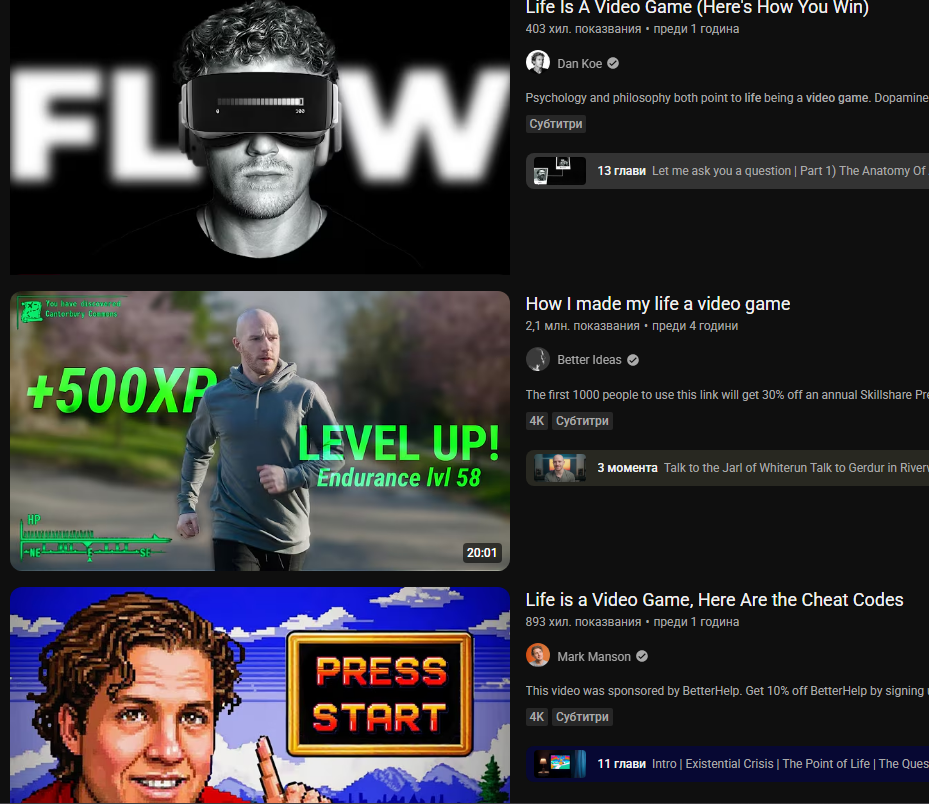
To sum it up ultimately you are: A whole and a part of a larger whole ( society ), developing itself through the four dimensions – self, body, culture, and system, experiencing shifting states of consciousness.
Remember that these are only four of his evergreen patterns that I showed you just to get an idea of how important interconnections are. I would definetly bring Ken Wilber’s theory back in future letters.
The beautiful thing is once you know these frameworks you can use them in every aspect of your life – business, health, relationships. Most importantly you don’t have to hold on to them. That’s the mistake 99% of people do. They are using one framework, one mindset, one belief system for their whole life. And the worse thing is that it’s most likely is assigned to them from outside factors. This could be a career, a religion or any belief system.
Let’s take a look at other pattern recognition traps you can fall into:
Confirmation bias and false patterns
Over-generalization
Analysis paralysis
The difference between correlation and causation
Unfortunately if you have already accepted something as an ultimate truth, you’ll start seeing “confirmations’ about it everywhere. For example if a 9-5 job is deeply involved in your philosophy about life, every time a business idea is mentioned, you’ll come up with arguments why it won’t succeed.
Most likely you’ll over-generalize with something like “90 percent of businesses fail…” , “Most people work a 9-5 anyway”.
These negative notions could stall your decisions even if you have the desire to start something new. You seek perfect information ( something that will grantee the success of the business idea ) or zero-risk choices which is impossible in practicality.
And the last bullet point – The difference between correlation and causation. Probably the most confusing pitfall that is related to pattern recognition.
The fact that two variables move together – X and Y doesn’t mean that X caused Y. or Y partially caused Y. It’s easy to confuse interconnections with causality with due to confounding, reverse causality, or selection bias. The fact that someone achieved something doesn’t mean that you’ll achieve the same thing if you follow the same steps. Often there is a third factor that drives both X and Y together.
How to avoid these traps?
Wisdom > Knowledge
Knowledge is about accumulating the ideas we talked about in your mind and subconsciousness.
Wisdom is about knowing when to implement them and when not to.
A skilled chess player knows all the universal principles about the game: whereto position his pieces in the beginning of the game, how to defend his king, how to approach each phase of the game etc.
But a great player knows when to break those rules based on the concrete reality of the current game.
Critical Thinking And Always Asking Questions
In your life you’ll encounter many ideas, beliefs, systems and values. And you’ll be exposed to as many people who would like to spread those ideas and find approval. You’ll work for other people’s projects, you start your own, fail and try again.
There is only one way to stay sane and grounded. You need to be critical and ask questions.
You need a radically open mind in order to strive in today’s changing world.
Only when you combine curiosity and knowledge with wisdom and agency, you’ll become truly unstoppable.
 ivosirakov.me